Derrik Mattson
Feb 27, 2026


TLDR - I want a Free Trail of ActiveCampaign
I've been using email marketing software for about seven years now. Started with MailChimp because everyone said it was beginner-friendly. Moved to Constant Contact for a client project. Tried Klaviyo when I started working with ecommerce brands. Even dabbled with ConvertKit for a bit.
Last year I switched everything to ActiveCampaign, and I'm honestly annoyed I didn't do it sooner. Not because the other platforms are bad (they're not), but because I was working way harder than I needed to for results that were just okay.
Here's the thing nobody tells you about email marketing platforms: they all send emails just fine. The difference is what happens before and after you hit send. That's where ActiveCampaign shines, and it's why I'm now moving every client I work with over to it.
Let me explain why you might want to consider switching too.
ActiveCampaign is an email marketing and marketing automation platform that combines email, CRM, sales automation, and customer experience tools in one place. Think of it as what happens when email marketing grows up and gets serious about actually converting leads into customers instead of just sending newsletters into the void.
The platform serves over 185,000 businesses across 170 countries. It's used by solopreneurs sending a few hundred emails a month and enterprises managing millions of contacts. The interface is clean, the automation is powerful, and the learning curve is manageable if you're willing to put in a few hours upfront.
You can use it for email campaigns, SMS marketing, abandoned cart recovery, lead scoring, sales pipeline management, and building complex automation workflows that would require three or four separate tools with most other platforms.
I liked MailChimp. It's easy, the templates look good, and it's free for small lists. But after about 18 months of using it, I kept running into the same frustrations.
The automation was too basic. MailChimp's automation is fine for simple stuff like welcome emails or birthday messages. But the second you want to do anything remotely sophisticated like "send different follow-ups based on which link someone clicked in the previous email," you're either hacking together workarounds or you're out of luck.
I had a client selling online courses. We wanted to send different email sequences to people based on which course topic they were interested in. With MailChimp, this required creating multiple audiences, complex segment rules, and manually moving people between lists. It was a mess.
In ActiveCampaign, I built the entire thing in about 20 minutes using conditional logic in one automation. Someone clicks on the "Marketing Course" link, they get the marketing sequence. They click "Design Course," they get the design sequence. Simple.
The CRM integration was awkward. MailChimp has a CRM now, but it feels tacked on. It's like they built an email tool and then tried to shove CRM features into it later. The contact records are limited, the sales pipeline is basic, and connecting email activity to actual deals requires mental gymnastics.
ActiveCampaign was built with CRM and email as integrated parts of the same system from the start. When a contact opens your email, clicks a link, or visits your pricing page, that activity shows up in their contact record and can trigger automations or update deal stages automatically.
Segmentation was a pain. MailChimp's segmentation works, but it's clunky. You can segment by basic stuff like location or signup date easily enough. But if you want to segment by behavior like "people who clicked this link but didn't buy within 7 days," you're building complex segment conditions that take forever and break easily.
ActiveCampaign's tagging and conditional logic makes behavioral segmentation actually usable. I can tag people based on what they click, what pages they visit, what they buy, and use those tags to trigger different automations. It's way more flexible.
I kept hitting the pricing wall. MailChimp's free plan is great until you hit 500 contacts, then you're paying. Fair enough. But the pricing jumps fast as your list grows, and you're paying more but not getting proportionally more value. At 10,000 contacts, I was paying MailChimp $350/month for pretty basic features.
ActiveCampaign at 10,000 contacts costs me $186/month on the Plus plan, and I'm getting way more functionality. The pricing isn't dirt cheap, but the ROI is better because the tools actually help me convert more leads.
Klaviyo is the elephant in the room for ecommerce. It's powerful, it's built for Shopify stores, and the email/SMS integration is excellent. I still recommend Klaviyo to pure-play ecommerce clients who only care about transactional emails and don't need much beyond that.
But here's where ActiveCampaign wins for a lot of businesses:
Klaviyo is ecommerce-only. If you sell digital products, do B2B lead generation, run a service business, or have any revenue stream that isn't ecommerce, Klaviyo is the wrong tool. It's built specifically for online stores. ActiveCampaign works for any business model.
Klaviyo gets expensive fast. At 5,000 contacts, Klaviyo costs $150/month. ActiveCampaign costs $129/month for the same size list and gives you CRM, sales automation, and advanced features Klaviyo doesn't have. At 25,000 contacts, Klaviyo is $625/month vs. ActiveCampaign's $286/month.
If you're doing $500K+/year in ecommerce revenue and Klaviyo's advanced segmentation is driving significant sales, the price is justified. But if you're a smaller store or you're doing anything beyond ecommerce, ActiveCampaign gives you more flexibility for less money.
ActiveCampaign's automation is more flexible. Klaviyo's flows are built around ecommerce events (abandoned cart, post-purchase, browse abandonment). They work great for that specific use case. ActiveCampaign's automation builder lets you create custom workflows for anything. If you run webinars, do B2B sales, offer consulting, or have complex customer journeys, ActiveCampaign handles it better.
The CRM actually matters if you're not just selling products. Klaviyo doesn't really have a CRM because ecommerce stores don't always need one. But if you're doing any kind of consultative selling, high-ticket offers, or B2B deals, you need pipeline management. ActiveCampaign includes a full sales CRM that integrates with your email campaigns.
I have a client who sells both a $50/month software product and a $5,000 implementation service. Klaviyo would handle the product emails fine but couldn't manage the sales process for the service. ActiveCampaign does both from one platform.
Let me be specific about what makes ActiveCampaign stand out, because "it's better" is meaningless without details.
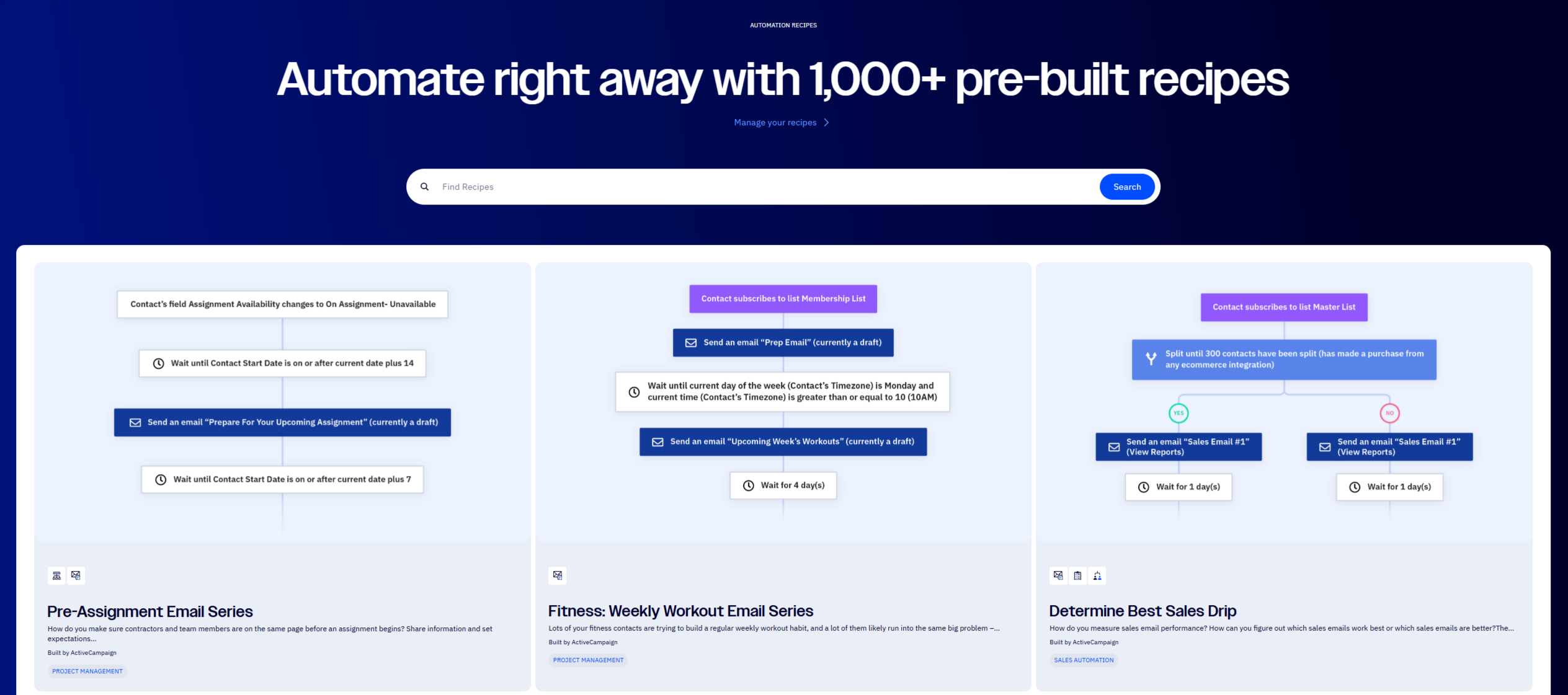
This is the core reason to use ActiveCampaign. The visual automation builder lets you create complex, multi-step workflows that respond to what people actually do, not just when they signed up or what list they're on.
You can build automations that:
I built an automation for a client that sends a different email sequence based on which of three lead magnets someone downloads. If they click on the "advanced" topic links in those emails, they get moved to a higher-value nurture sequence. If they don't engage after 7 days, they get a re-engagement campaign. If they visit the pricing page, sales gets notified.
This entire workflow would require three separate tools and a bunch of Zapier connections with most email platforms. In ActiveCampaign it's one automation that took about 30 minutes to build.
Most email platforms either don't have lead scoring or it's so basic it's useless. ActiveCampaign's lead scoring is flexible and genuinely helpful for prioritizing who to follow up with.
You assign points for positive actions (opens email: +1, clicks link: +3, visits pricing page: +10, fills out contact form: +50) and subtract points for negative signals (unsubscribes: -20, hasn't opened in 30 days: -5).
Your sales team can focus on people with scores above a certain threshold instead of wasting time on cold leads. You can trigger automations based on scores. High scorers get immediate sales follow-up. Low scorers get more nurture content.
I set this up for a B2B software client. Leads below 30 points get nurture emails. 30-60 points get sales emails. Above 60 points, a sales rep gets notified to call them immediately. Their close rate went up about 40% just from talking to the right people at the right time.
ActiveCampaign has a full CRM built into the platform. You can manage your sales pipeline, track deals, assign tasks, and see every interaction a contact has had with your business in one place.
When someone moves from being a marketing lead to a sales opportunity, you create a deal and move them through your pipeline stages. All their email history, website visits, and engagement data travels with them. Your sales team sees exactly what emails they've received and what they've clicked on before they even get on a call.
This matters because most businesses use one tool for marketing (MailChimp, Constant Contact) and a different tool for sales (HubSpot, Pipedrive). Those tools don't talk to each other well, so marketing and sales are basically playing telephone.
With ActiveCampaign, marketing and sales share the same database. When marketing hands off a lead to sales, sales sees everything. No more "did you send them the case study already?" confusion.
ActiveCampaign's site tracking feature monitors which pages people visit on your website and can trigger automations based on that behavior.
Someone visits your pricing page three times but doesn't buy? Send them an email addressing common objections. Someone spends 10 minutes on a specific product page? Tag them as interested in that product and send relevant case studies.
I use this for abandoned browse sequences. If someone visits multiple product pages but doesn't add anything to cart, we send an email highlighting those specific products they looked at. The personalization significantly outperforms generic "check out our products" emails.
Most email platforms let you A/B test subject lines. Maybe they'll let you test send times. ActiveCampaign lets you split test entire automation paths.
You can send 50% of people down one automation sequence and 50% down a different sequence, then measure which one converts better. You can test different offers, different content, different timing, whatever you want.
I ran a test where half of new leads got a 5-email welcome sequence over 10 days, and half got a 7-email sequence over 14 days. The 7-email sequence had a 23% higher conversion rate, so now everyone gets that version. I never would have known that without being able to test the whole sequence.
This is harder to measure objectively, but ActiveCampaign's deliverability rates are excellent. They maintain strong relationships with ISPs, enforce list hygiene rules, and have infrastructure that reliably gets emails into inboxes instead of spam folders.
I've compared open rates for the same email lists before and after switching from MailChimp to ActiveCampaign, and I saw about 3-5% higher open rates on average with ActiveCampaign. Not night and day, but meaningful when you're sending to tens of thousands of contacts.
They also provide deliverability tools like spam testing before you send, domain authentication setup, and recommendations for improving your sender reputation.
ActiveCampaign isn't perfect. Let me tell you what frustrated me so you go in with realistic expectations.
The learning curve is real. ActiveCampaign can do a lot, which means there's a lot to learn. If you're coming from MailChimp where you basically just write an email and hit send, ActiveCampaign can feel overwhelming at first.
The automation builder is powerful but not intuitive if you've never used marketing automation before. You need to understand concepts like tags, conditional logic, and trigger-based workflows. Plan to spend a few hours learning the platform before you're productive with it.
SMS is additional cost. ActiveCampaign includes email in your subscription, but SMS is extra. You buy SMS credits separately. Klaviyo includes SMS in their plans. If SMS is a major channel for you, this pricing structure might be annoying, just depends on your business.
Ecommerce-specific features lag Klaviyo. If you're running a Shopify store and you want deep ecommerce analytics, product recommendation engines, or sophisticated revenue attribution, Klaviyo is purpose-built for that and does it better.
ActiveCampaign's ecommerce features work (abandoned cart, post-purchase emails, etc.) but they're not as advanced. It's a general-purpose marketing platform that handles ecommerce, not an ecommerce platform that happens to do email.
Support response times vary. I've had great experiences with ActiveCampaign support where I got helpful responses in under an hour. I've also had tickets that took 2-3 days to get a real answer.
The quality of support is generally good (they know their product), but if you're on a lower-tier plan, you might wait longer for responses. Higher-tier plans get priority support.
ActiveCampaign's pricing is middle-of-the-road. Not the cheapest, not the most expensive, but you need to understand what you're actually paying for at each tier.
You can also try this 25% off ActiveCampaign Coupon Code WELCOME25
They offer four plans: Lite, Plus, Professional, and Enterprise. Pricing scales based on your contact count.
Lite Plan (starts at $15/month for 1,000 contacts):
This is fine if you're just starting out or you only need basic email marketing. You can send campaigns and set up simple automations. But you don't get the CRM, lead scoring, or advanced automation features that make ActiveCampaign worth using over cheaper alternatives.
Honestly, if Lite is all you need, you should probably just use MailChimp or a cheaper platform.
Plus Plan (starts at $49/month for 1,000 contacts):
This is the sweet spot for most businesses. The CRM and lead scoring are included, which is where ActiveCampaign starts to differentiate from basic email platforms. This is the minimum tier I'd recommend if you're switching from another platform.
Professional Plan (starts at $79/month for 1,000 contacts):
This is for established businesses that need advanced features and have the traffic/contacts to justify the cost. If you're doing serious marketing automation and optimization, Professional tier unlocks tools that can meaningfully improve conversions.
Enterprise Plan (custom pricing):
For large organizations with complex needs. Most businesses won't need this.
How pricing scales:
Compared to competitors at 5,000 contacts:
ActiveCampaign is more expensive than MailChimp or ConvertKit but cheaper than Klaviyo, and you're getting significantly more functionality than MailChimp or ConvertKit at that price point.
Not everyone needs to switch. But if any of these situations sound familiar, ActiveCampaign will probably serve you better than what you're using now.
Your current platform's automation is too limited. If you're constantly thinking "I wish I could send different emails based on what people clicked" or "I want to trigger emails when someone visits a certain page," you've outgrown your current tool.
You're using multiple tools that don't talk to each other. If you have MailChimp for email, Pipedrive for CRM, and Zapier holding everything together with digital duct tape, ActiveCampaign consolidates all of that into one platform.
You need to connect email activity to sales outcomes. If you're doing any kind of considered purchase (B2B, services, high-ticket products), you need to know which marketing activities are actually leading to closed deals. ActiveCampaign's CRM integration makes this visible.
You're leaving money on the table with basic segmentation. If you're sending the same emails to everyone on your list instead of personalizing based on behavior, you're losing conversions. ActiveCampaign makes behavioral segmentation actually usable.
You want to scale without adding headcount. Well-built automations in ActiveCampaign can handle lead nurture, qualification, and handoff to sales without humans touching every lead. This lets you grow revenue without proportionally growing your team.
Your current platform is expensive and you're not using its unique features. If you're paying for Klaviyo but you're not really using the ecommerce-specific features, or you're paying for HubSpot but using 20% of the functionality, ActiveCampaign might give you what you actually need for less money.
ActiveCampaign isn't the right fit for everyone.
Stick with MailChimp if: You're just sending occasional newsletters, you have a small list, and you don't need automation. MailChimp's free plan is unbeatable for simple use cases.
Stick with Klaviyo if: You're running a pure-play ecommerce business, you're doing over $500K/year in revenue, and Klaviyo's advanced segmentation and attribution are directly driving sales. The ROI justifies the cost.
Stick with ConvertKit if: You're a creator or blogger who just needs simple email sequences and broadcast emails. ConvertKit is easier to use and cheaper for basic needs.
Stick with HubSpot if: You need full marketing, sales, and service suites all integrated, and you have the budget for enterprise software. HubSpot is more expensive but more comprehensive.
Don't switch to ActiveCampaign if: You're not willing to invest time learning the platform. If you just want to write emails and hit send, ActiveCampaign is overkill and you'll be frustrated by the complexity.
Here's what the process actually looks like.
Importing contacts is straightforward. ActiveCampaign can import from CSV files or directly connect to most major email platforms. You export your list from MailChimp (or wherever), import to ActiveCampaign, map the fields, and you're done. Takes maybe 30 minutes.
Recreating automations takes time. You can't just copy/paste your old automation workflows. You need to rebuild them in ActiveCampaign's automation builder. This is where you'll spend most of your migration time.
The good news is you're rebuilding them in a better system, so you can usually simplify and improve them in the process. Budget a few hours to a few days depending on how many automations you have.
Email templates need to be rebuilt. You can't import templates directly. You either use ActiveCampaign's templates and customize them, or you rebuild your existing templates in their editor.
If you have tons of custom templates, this is annoying. If you only have 5-10 core templates, it's manageable.
Historical data doesn't transfer. Your old campaign performance data stays in your old platform. ActiveCampaign starts fresh. This isn't ideal if you want historical reporting, but it's not a dealbreaker.
Set up takes longer than you think. Between importing contacts, rebuilding automations, setting up site tracking, configuring the CRM, and testing everything, expect to spend at least a full day (probably more like 2-3 days) getting everything working properly. But that is kind of normal for a switch like this.
You can do this gradually. Import your list, set up a few key automations, and migrate campaigns over time while keeping your old platform running. Most people run parallel for a few weeks before fully cutting over.
ActiveCampaign offers migration services if you're on Professional or Enterprise tiers. They'll help with the technical migration, which speeds things up significantly.
Let me give you actual numbers from clients who switched so you can gauge whether this is worth the effort.
Client 1: B2B SaaS company, switched from MailChimp
Client 2: Online course creator, switched from ConvertKit
Client 3: ecommerce store, switched from Klaviyo
This client's revenue actually dropped slightly but they didn't care because the ROI was still positive and they were saving money. Klaviyo's ecommerce features are legitimately better for pure-play ecommerce.
Client 4: Service business, switched from Constant Contact
These aren't universal results. Your mileage will vary as they say, based on how well you implement the platform and how good your email strategy is. But the pattern is clear: better segmentation, automation, and CRM integration typically drives measurable improvements.
ActiveCampaign offers a 14-day free trial (some promotions extend this to 30 days). Here's how to use the trial to actually evaluate whether this is the right platform for you.
Day 1: Import a segment of your list Don't import your entire database on day one. Import 500-1,000 contacts from a segment you want to test with. This keeps things manageable and speeds up the setup.
Day 2-3: Build one core automation Pick your most important automation (welcome sequence, abandoned cart, lead nurture, whatever drives the most revenue) and rebuild it in ActiveCampaign. This forces you to learn the automation builder and see if it can do what you need.
Day 4-5: Set up basic site tracking Install the ActiveCampaign tracking code on your website. Set up a simple automation triggered by visiting a specific page (like your pricing page). See if the tracking works and if the triggers fire correctly.
Day 6-7: Create and send one campaign Build an email using their templates, segment your test audience, and send it. See how the editor works, check deliverability by monitoring open rates, and compare to your current platform.
Day 8-10: Explore the CRM Create a few test deals in the pipeline. Add notes, tasks, and see how the contact records display email activity. See if this would actually help your sales process or if it's overkill.
Day 11-12: Test lead scoring Set up a basic scoring system. Assign points for opens, clicks, and page visits. See which contacts bubble to the top and whether those are actually your best leads.
Day 13-14: Evaluate reporting and decide Look at the reports from your test campaign and automation. See if the data you need is accessible. Compare results to your current platform. Decide if the switch is worth the migration effort.
If you run through this checklist, you'll have a pretty good sense of whether ActiveCampaign fits your needs or if you should stick with what you have.
I've been using ActiveCampaign as my primary email platform for about 14 months now. I manage my own list plus six client accounts through it. Here's what I actually think.
It's not the easiest platform. If you want something you can figure out in 20 minutes, this isn't it. There's a learning curve, and you'll spend time in the beginning building automations and understanding how everything connects.
But that complexity is the point. You're getting powerful tools that can do sophisticated things. The tradeoff is worth it if you need those capabilities.
The ROI is there if you use it properly. Just switching platforms and sending the same basic campaigns you always sent won't improve anything. The value comes from using the automation, segmentation, and CRM features to actually change how you do email marketing.
If you put in the work to segment based on behavior, score leads, and build smart automation workflows, you'll see better results. If you just want a place to send newsletters, stick with something simpler and cheaper.
It's not perfect but it's better than the alternatives I've tried. The email builder could be more polished. The reporting could be more visual. Support response times could be faster. But when I compare ActiveCampaign to the other platforms I've used, it wins on the things that matter most: automation flexibility, CRM integration, and actually helping me convert more leads.
The pricing is fair for what you get. $129/month for 5,000 contacts on the Plus plan is not cheap, but you're getting email, automation, CRM, site tracking, and lead scoring in one platform. If you were buying those capabilities separately, you'd pay way more.
I'm not switching to anything else anytime soon. That's probably the best endorsement I can give. I've tried enough email platforms to know the grass isn't always greener. ActiveCampaign does what I need, does it well, and the ROI justifies the cost.
If you're frustrated with your current email platform's limitations, if you're trying to connect marketing and sales data, or if you just want more powerful automation without needing a developer, ActiveCampaign is worth the 14-day trial.
Worst case, you spend two weeks testing it and decide to stick with what you have. Best case, you find a platform that actually helps you convert more leads and makes your marketing automation work the way you always wanted it to.
[Start your free 14-day trial of ActiveCampaign here] - No credit card required, full platform access
Also copy this ActiveCampaign Coupon Code for 25% Off! WELCOME25
Choosing the right amount of life insurance is a crucial step in protecting your family's financial future.
Enter your ZIP CODE, AGE and IF YOU SMOKE, then click UPDATE. The companies below will be tailored specifically to you.
High Yield Savings Accounts can be a convenient and safe way to keep, manage and access money you need for the short to mid term. Most of these banks have more aggressive interest rates than your typical bank. View Details Below
Shopping for car insurance is no one's idea of a good time. All anyone really wants is comprehensive protection without breaking the bank. Use this simple and convenient tool to help you find the best car insurance plan to fit your life.
Enter your ZIP CODE, AGE and NUMBER OF DRIVERS, CHECK APPROPRIATE BOXES, then click UPDATE. The companies below will be tailored specifically to you.